Training Topics
Adaptability: Courses

Overcoming Obstacles in Cross-functional Teams
Perception and bias play a crucial role in communication. Understanding our perceptions and biases enables us to look beneath the apparent facts and impressions we experience, search for meaning we might not otherwise find, and communicate more openly with others. This one- to three-day experience-based learning format uses a number of short exercises, activities and a half-day simulation which provides an indelible learning experience illustrating ways of overcoming bias and managing diversity. The program content is such that an extended customized debrief of the simulation is an option. Overcoming Obstacles is an ideal program for members of senior management to address issues that arise from working with others having diverse functional backgrounds and for members of global teams.
Back to grid
Operating in Complex, Changing Environments
Working in today's organizations is a challenging and sometimes frustrating experience where juggling priorities is the norm. This program focuses on the dynamics of complex organizations, how they affect the people in them, and how to empower ourselves and others. A tool used to enhance self-understanding and improve relationships is the Myers-Briggs Type Indicator®. A popular component of the program is feedback from co-workers on the participants' skills. Attendees leave with strategies to improve interpersonal relationships, ways to increase productivity, and practice with on-the-job situations.
Back to grid
Advanced Problem Solving in R&D
Technical specialists, while achieving high levels of sophistication in their own fields, are not often trained on technical problem-solving methods needed for effective performance in the interdisciplinary group efforts required today. The focus of this program is on the activities, methods, and strategies involved in identifying and solving technical problems including practice with specific problems critical for R&D and the use of several effective techniques for generating new ideas. This program is given in two to four days. The longer program is appropriate when taken by intact work teams where significant time is spent on the team's work issues.
Back to grid
Innovative Thinking and Creativity
How well an individual or company is able to respond to problems and innovate remains a key distinguishing factor between success and failure. Learning new ways of thinking expands our creativity, adaptability, and competence to deal with problem situations. Using the INQ (Inquiry Mode Questionnaire), participants in this program analyze their own thinking preferences, how those preferences impact approaches to solving problems and making decisions, and how they may differ from the approaches others use. An option is the use of an innovation profile in which a confidential report is generated from a pre-program survey comparing views of self, peers, managers, and team members on the participant's skills in creativity, commitment, and managing innovation.
Back to grid
Developing a Culture of Customer Service
In today's marketplace strong customer service skills are essential. This two-day course defines "customer" and develops approaches to improving customer satisfaction and retention by enhancing personal and business relationships. Participants learn how to modify their own interpersonal communication strategies and acquire new skills to positively influence others and resolve conflicts, leading to a culture of responsiveness. This program is suitable for administrative or managerial staff who have contact with either internal or external customers.
Back to grid
Managing Effective Meetings
Meetings are a crucial element of business and yet can be a big time waster if not managed well. This program will help improve handling of meetings so that they run efficiently and effectively. Topics include creating meeting agendas that work, focusing on outcomes, establishing meeting ground rules, and establishing an easy way to capture and distribute meeting minutes that hold people accountable.
Back to grid
Resolving and Managing Conflict
Managing conflict to resolve differences and improve relationships is a critical skill for managers and workers. This program is designed to teach a simple, workable model for managing conflicts and provide real-life situations on which to practice. We use standard examples of conflict management found in most work settings or specific custom cases of conflict typical in your organization to further increase the benefit of this program. It is offered in half-day, one-day, and two-day versions.
Back to grid
Strategic Partnering - Activities to Improve Alliances and Outsourcing Relationships
Strategic Partnering enhances understanding of the complex business relationships and broadens perspectives on the stages and activities that contribute to a successful project involving key partners. Participants can develop strategies to overcome typical problems such as contract delays, conflicts, partnership snafus, and obstructions to improvement. This workshop uses a variety of learning tools, including case studies, team activities, and Partnering Success - The Challenge to experience the issues and overcome roadblocks in strategic partnering.
Back to grid
Managing Multiple Priorities
This two-day program is designed to develop skills to juggle multiple assignments and to enhance interpersonal communication. Having multiple priorities or more than one boss can hamper the effectiveness and efficiency of any staff member without the appropriate training. Being able to manage your time and energy includes building a "team" with your boss. The Myers-Briggs Type Indicator® is used to build a foundation for communicating and building this team. An option is for the participants' managers to attend a portion of the program. Together they discuss ways of improving working relationships, joint action-planning, and use the MBTI and a custom Side-by-Side report comparing participant and manager work styles and preferences.
Back to grid
Consulting Skills
Working in today's organizations requires the ability to help others, whether or not we are in a service profession. This two- to three-day program addresses the behaviors and skills which foster a productive consulting, helping relationship. In addition, each participant receives feedback from coworkers on their own consulting skills to provide a foundation on which to build during the program and back on the job.
Back to grid
Managing Change
Many corporations faced with diminishing resources find increasing pressure to proactively respond to planned and unplanned change. In a quickly changing world, a primary measure of future success is the ability to assimilate change. Many stress related physical symptoms comes from not knowing how to adjust to these changes. Managing Change is an experiential program that is aimed at increasing your understanding of change and providing a survival guide on coping with increasing rates of change.
Back to grid
Decision Making
How well an individual or company responds to issues and makes decisions is a key distinguishing factor between success and failure. Our unique ways of thinking have a profound effect on what we do and how we do it. Using the INQ (Inquiry Mode Questionnaire), participants in this program analyze their own thinking preferences and how those preferences impact approaches to solving problems and making decisions. Topics include recognizing and breaking barriers, thinking strategies, and group decision making.
Back to grid
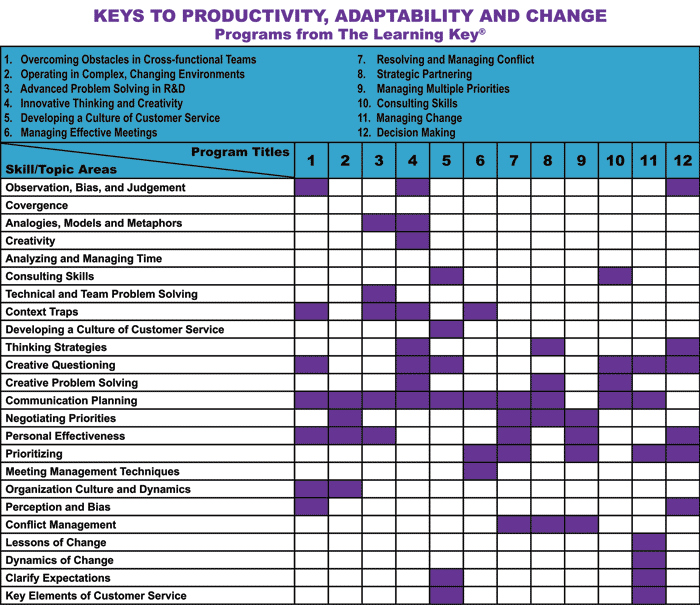
Click on a title for course description